
Planning to sell your property in Cambodia?
In recent years, the Cambodian government has been phasing in the Capital Gains Tax (CGT), a 20% tax on the profit you make when selling assets for more than you originally paid.
Quick Summary
| Category | Details |
| Start Date | September 2025 (general), January 2027 (real estate) |
| Tax Rate | 20% on profit, or about 4% of sale price using the lump sum method |
| Who Pays | Residents (all property owned including overseas), Non-residents (only on properties in Cambodia) |
| Exemptions | Main home 5+ years, agricultural land, inheritance, family gifts |
| Payment Deadline | Within three months of sale |
| Authority | General Department of Taxation (GDT) |
For real estate, CGT will officially apply starting 1 January 2027. This delay allows property owners, developers, and tax authorities more time to prepare documentation, align valuations, and ensure a smoother rollout.
Here’s what property owners and investors should know about the upcoming change:
What Is Capital Gains Tax?
Capital Gains Tax (CGT) is a 20% tax on your profit when you sell real estate. It does not apply to the full sale price. It only applies to the gain between your buying price and your selling price. Example: If you bought a property for $100,000 and sold it for $130,000, your profit is $30,000. The tax would be 20% of $30,000 = $6,000.
When Does It Start?
CGT on Real estate or immovable property is set to be implemented from 1 January 2027. The government delayed the inclusion of real estate in order to give property owners, developers, and tax authorities more time to prepare, to organize records, adjust valuation methods, and ensure smoother implementation when the new rules take effect.
Who Has to Pay?
- Cambodian residents: Must pay CGT on profits from selling any property, including multiple holdings, located in Cambodia or abroad.
- Foreign property owners: Pay CGT only on property located in Cambodia.
So if you are a foreigner selling a property in Phnom Penh or Siem Reap, or anywhere in Cambodia, the tax applies to you.
What Types of Property Sales Are Affected?
CGT applies when you sell or transfer:
- Condominiums
- Houses or villas
- Land or plots
- Other immovable property
It does not apply to rental income. CGT is only charged on sales that generate profit.
Exemptions You Should Know About
The following property types are exempt from Capital Gains Tax under Cambodia’s current tax regulations:
- Your main home, if you have lived there for five years or more
- Agricultural land used for farming
- Inherited property
- Property given as a gift to a direct family member
These exemptions are based on official guidelines from the General Department of Taxation (GDT). If you’re unsure whether your property qualifies, an IPS agent can help you verify your eligibility with the local tax office.
How the Tax Is Calculated for Real Estate
When selling property, you can choose one of two ways to calculate your taxable gain.
1. Actual Cost Method
You declare your real costs such as the purchase price, renovation costs, and selling expenses. The 20% tax is then applied to your net profit (sale price minus allowable costs). Example: You bought a villa for $120,000 in 2019. Over the years, you spent $10,000 on renovations and $5,000 on selling costs such as agent fees and minor upgrades. In 2026, you sell the property for $160,000. Your profit is calculated as: $160,000 − ($120,000 + $10,000 + $5,000) = $25,000 profit The CGT is 20% of your profit: 20% × $25,000 = $5,000 tax payable This method works best if you have detailed documentation such as invoices and receipts.
2. Standard Deduction (Lump Sum) Method
This option is simpler. The government allows you to deduct 80% of your sale price as assumed expenses. You then pay tax on the remaining 20%, which means your effective tax rate is around 4% of the sale price. Example: Suppose you sell a villa for $200,000.
Under the lump sum method, 80% ($160,000) is treated as assumed expenses:
Only $40,000 counts as taxable profit 20% of $40,000 = $8,000 tax payable
Most sellers prefer this option because it is straightforward and predictable.
What If You Sell Below What You Paid?
If you sell a property for less than your purchase price, in other words, at a loss, you won’t owe any Capital Gains Tax (CGT) because there is no gain to tax. However, you still need to declare the transaction to the General Department of Taxation (GDT) and submit the relevant documents showing purchase costs and sale price.
If tax authorities find your declared sale price much lower than market value, they may ask for proof or use their own valuation to verify whether the sale was under-declared.
Property Registration and Tax Card
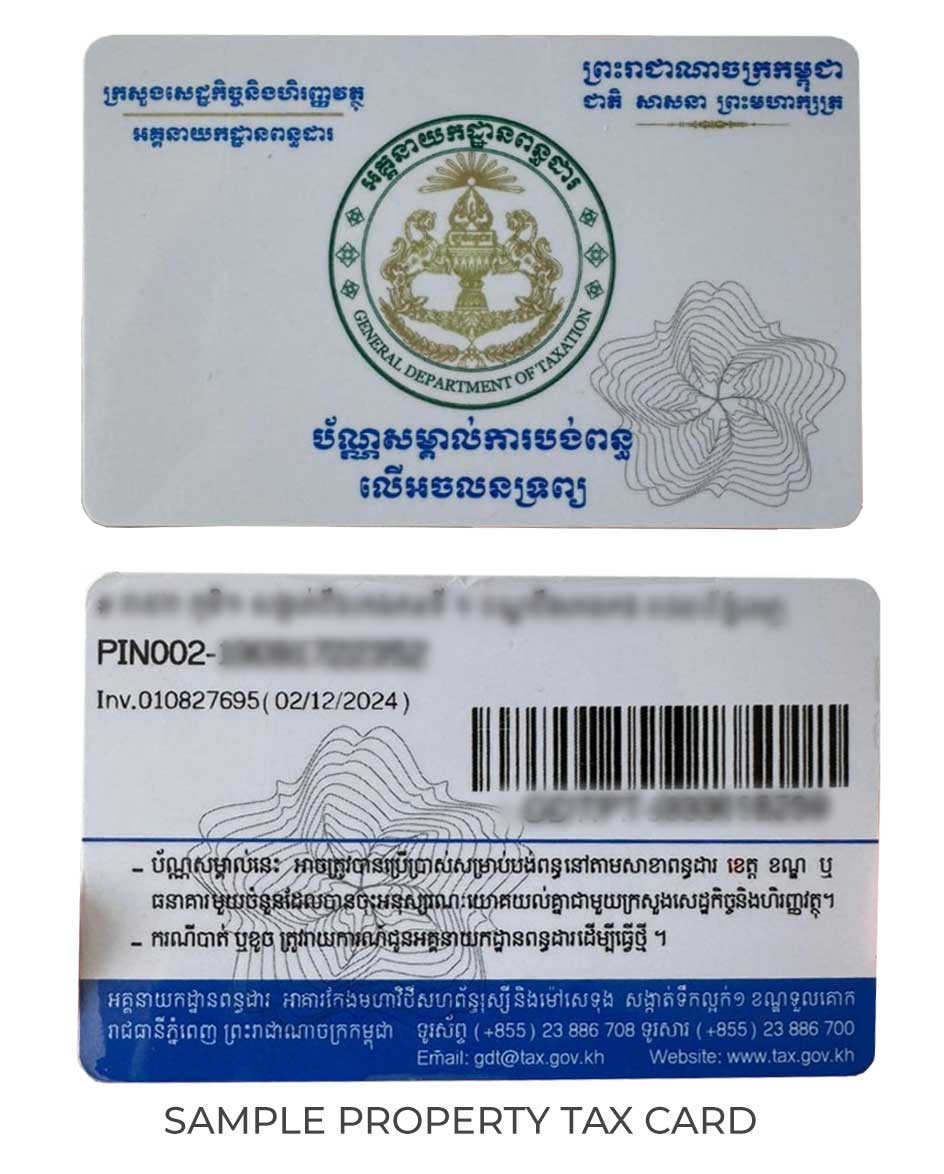
When you buy or sell property in Cambodia, your property must be recorded in the national tax system. This is usually done through the property tax card issued by the General Department of Taxation (GDT).
What Is a Property Tax Card (PT 01)?
The property tax card, officially called Form PT 01, links your property to your tax records. It allows the GDT to verify ownership and ensure the correct property tax payments are made. Documents typically required include:
- Ownership certificate or transfer agreement (dfdl.com)
- ID card, passport, or residence certificate for foreigners
- Property photos and location details
- Utility bills (if available)
- Relevant construction or site permits verified by local authorities (tax.gov.kh)
Is This Something You Need to Register Yourself?
In most cases, you don’t have to worry about this step separately. When you buy new property, or when a title is being transferred through official channels, the tax registration process is usually completed as part of that title processing, as long as the request for tax registration is included in the transfer paperwork.
Dive deep: How Title Transfer Works in Cambodia
However, if your property does not yet have a tax registration card (for example, older properties or those that have never been formally registered), you will need to visit your local or provincial tax branch to complete the registration yourself. (dfdl.com)
Why This Matters
- Proper registration ensures your property is fully recognized in the GDT system.
- It prevents any issues or delays when paying taxes or declaring Capital Gains Tax in the future.
- It also helps confirm eligibility for any available exemptions or deductions when selling.
When and How to Pay CGT
Once your property is sold:
- You must declare and pay CGT within three months of the sale.
- Payment is made at the General Department of Taxation (GDT), usually at a local tax office.
- When paying, it’s advisable to bring your property tax registration card (PT 01) or the tax registration ID / previous tax receipt, if you already have it. (This matches practice in existing property tax payments and helps the tax office verify your records.)
- Keep copies of your sale contract, property deed, tax card, registration documents, and receipts to support your filing and verification.
Why Cambodia Is Introducing CGT
The government’s main goals are to:
- Create fairer taxation among property owners and investors
- Align Cambodia’s tax system with international and ASEAN standards
- Encourage greater transparency in real estate transactions
While this introduces an extra step for sellers, it also shows that Cambodia’s property market is becoming more structured and internationally aligned.
IPS Insight
At IPS Cambodia, we guide both local and international property owners through every step of buying and selling. That includes helping you understand new rules like Capital Gains Tax and property registration. Our team can help you estimate your tax, prepare your documents, and plan your sale with confidence.
📩 Need help selling your property or calculating your CGT?
Contact your favorite IPS agent today!
